An on-the-rise Toronto Raptors team appears to be up against it going into a playoff series against the Cleveland Cavaliers. Sound familiar?
There’s no need to fear – LeBron James isn’t standing behind that door ready to ball spin and break a collective basketball nation’s heart. It’s nearly one decade later, and a great deal has changed. The Raptors won a championship, James is catching lobs from his son, and about a dozen new catch-all metrics dropped that dubiously distill a player’s worth into a single number.
Fast forward to 2025-26 and the burgeoning Raptors have taken serious strides, discovering strengths and limitations along the way to securing their first playoff berth in four years. And there’s plenty of data to analyze, as Toronto has achieved success in new and intriguing ways.
Unlike the Kyle Lowry and DeMar DeRozan-led squads of the mid-2010s, the Raptors are now a defence-first group that thrives off turning opponents’ misses and turnovers into easy points. They were able to play their game against the Cavaliers in the regular season, sweeping that series 3-0. But those results come with plenty of caveats.
Donovan Mitchell missed one game, Jarrett Allen missed two and Darius Garland missed all three. And of course, Garland’s replacement, James Harden, wasn’t a member of the team yet. Acquiring the former MVP for Garland at the deadline has supercharged Cleveland’s already strong offence. With that in mind, let’s dig deep into five stat trends to watch for the Raptors in the first round, and potentially beyond.
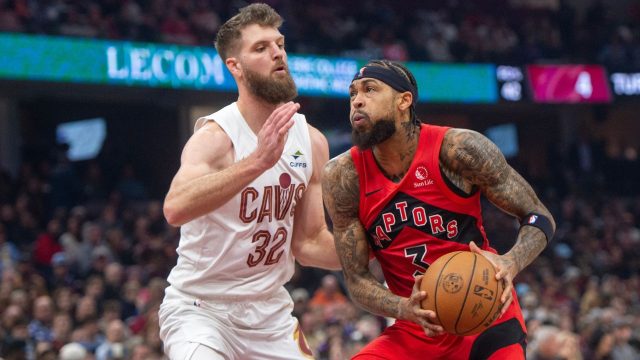
-
Raptors return to the playoffs on Sportsnet
The Toronto Raptors are back in the playoffs for the first time since 2022. Watch Game 1 against the Cleveland Cavaliers Saturday at 1 p.m. ET/ 10 a.m. PT on Sportsnet ONE and Sportsnet+.

1. The Raptors want to play fast
Toronto’s ability to dictate the pace of play and win the possession battle could define its success in the first round.
The Raptors led in the NBA in fast-break points this season. They ranked third in overall transition scoring. And they did it while ranking in the bottom 10 in transition efficiency over the first five months of the schedule. The Raptors didn’t score well when defences weren’t set; they just faced scrambled defences a lot – the third-most in the NBA.
Toronto fans will know well, but for anyone unfamiliar, the Raptors’ trying to finish odd-man breaks and easy runouts often resulted in a comedy of errors.
Still, they ran the fourth-most frequently off steals and the most frequently off rebounds (according to Cleaning the Glass, which filters out garbage time). Transition chances materialize much more easily off steals than live rebounds – 67 per cent of the time vs. 29 per cent of the time – so this demonstrates their commitment to getting out in transition at every opportunity.
One way they accomplished this was by using a philosophy Darko Rajaković described as “first touch,” meaning that the rebounder immediately looks up court to make a hit-ahead pass to a player leaking out as an outlet. They also have big wings in Scottie Barnes and Brandon Ingram, who are capable of both rebounding the ball and pushing. Collin Murray-Boyles and Sandro Mamukelashvili also fit this mould to a lesser degree.
Basically, the Raptors want to play fast.
It’s easy to understand why. Even when the Raptors were finishing at a below-average clip in transition, it was still far more efficient than in the halfcourt. The league average points per 100 transition plays is 125.8. Against a set defence, that number drops to 98.1. Running against a still-recovering defence is always going to be more effective than the alternative, and the Raptors have been among the best teams at creating those opportunities.
The same logic can also be applied going the other way, and the Raptors have been successful here too. They have limited opponents to the second-lowest transition frequency through a mix of curbing turnovers and being extra intentional about tagging up with their man when the shot goes up, as Raptors assistant coach Jama Mahlalela explains.
Moreover, this important element is trending in the right direction for the Raptors on a couple of fronts.
First, their transition finishing greatly improved over the final month of the season, bumping them up to 15th (just above league average at 126.5 points per 100). And while they didn’t convert consistently in their first win over Cleveland, they put up monster numbers of 142.9 and 144.4 in their next two matchups, respectively.
The Cavaliers were also below average at preventing teams from getting out in transition, ranking 18th. They also ranked 18th in opponents’ fast-break points, but have been seventh since adding Harden, mostly due to his ability to limit turnovers as a lead ball handler.
The Raptors’ success here, both recently in finishing and on the season against Cleveland, seemingly bodes well for them. But once again, the Harden caveat looms large.
2. Change of the guard
Even before Immanuel Quickley was plagued by plantar fasciitis and missed eight games down the stretch, the Toronto Raptors had already begun to initiate offence differently.
The most notable example came against the Detroit Pistons on March 15, when the Raptors shook out of their funk of habitually pounding the chalk – Toronto was 4-18 against teams with top-10 records in the NBA to that point, with three of those wins coming over the Cavs – by also breaking a pattern of play and taking down the No. 1 seed.
The Raptors’ crunch-time offence had grown stagnant to that point. Their go-to action was Quickley entering the ball to Ingram in the post after he shook free off a cross-screen. That bore fruit in earlier clutch wins over the Charlotte Hornets and Philadelphia 76ers, but opponents started to sit on it, gum it up, and the Raptors were eventually eating the majority of the shot clock just to get it off.
These forced possessions aside, Ingram’s natural pace is that of molasses. The Raptors’ average possession was nearly a full second longer with the languid wing on the floor (per PBP Stats), the highest mark on the team and nearly four times that of Poeltl, who was second.
Toronto will still rely on Ingram to create plenty of offence, but they seem to be leaning towards having him start with the ball more often, instead of burning clock working to get open. The all-star usually ended up taking on his defender one-on-one either way. In that aforementioned Pistons game, every Raptors starter except for Jakob Poeltl initiated a possession in the final five minutes, with all of them doing it multiple times except for Quickley.
With Quickley’s status now in question due to a mild hamstring strain sustained in the final game of the regular season, it might not matter. And the Raptors did already get practice filling the void at point guard. Barnes averaged 10.6 assists over Quickley’s eight-game absence as the Raptors’ pace shot up by 1.5 possessions per 48 minutes (an eight-spot leap in the leaderboard), and teammates were delivered the ball in more optimal positions to score.
After the Raptors’ second win over the Cavaliers, Ingram told me that Quickley is “able to be at his normal position scoring the basketball, getting into the lane. Still seeing passes, but he’s able to be more of a scorer than (a) facilitator when Jamal (Shead) is out there.”
It was telling that Quickley’s teammate saw him playing a more suitable role when Shead was handling point guard duties. Still, Quickley is Toronto’s most talented three-point shooter; he’s the only player on the team who attempts a high volume of more difficult pull-up triples, accounting for nearly 40 per cent the team’s attempts. Without Quickley, the Raptors have almost no pull-up shooting – eight players averaged more pull-up threes per game than the Raptors did as a team this season.
3. The Raptors have started shooting it
The Raptors have recently spent time without their best shooter, and counterintuitively, their poor three-point shooting has started to turn around.
While they rank among the lowest-volume distance shooting teams in the league, both on pull-ups (4.9 attempts per game, last) and overall (32.1 attempts per game, 26th), Toronto’s efficiency has improved. Pre all-star break, it ranked 25th at 34.4 per cent, and since then, it’s been sixth at 37.7.
The bulk of this can be attributed to Ja’Kobe Walter, who’s been pumping heat to the tune of 47.6 per cent from three on 4.7 attempts per game after the mid-February festivities – over a 12 per cent increase on an additional 1.5 shots. The 21-year-old sophomore has always had quiet and repeatable shooting mechanics, and it appears he’s put it together, while also serving as the Raptors’ best on-ball defender at the point of attack. He stands to play an important role in the series as a hot shooting night, or shutdown defence on Mitchell, could go a long way in swinging a game. If Quickley is unable to go, it’s probable Walter enters the starting five in his place – as he did for seven of the eight-straight games Quickley sat.
Ingram, Mamukelashvili, and even AJ Lawson have also had notable upticks in three-point efficiency post all-star break, albeit on less volume. Outside of his threes, Ingram had one of the most difficult shot diets in the league. In contrast, the Raptors’ role players are given the ball in very specific spots. The vast majority of Walter, Mamukelashvili, and Lawson’s usage came on cuts and spot-ups, which are among the most efficient play types. To their credit, they’ve executed, all posting above-average true shooting percentages. Walter and Mamukelashvili’s were 61 per cent and 63.7 per cent, respectively. Huge numbers.
The Raptors’ role players maintaining this level of shooting efficiency will be important if they’re going to have a chance against the Cavs.
4. Unique success in the clutch
During the regular season, the ability to navigate clutch basketball can swing a team’s record by a few wins. In the playoffs, it could save the season. The 2025-26 Raptors excelled in clutch scenarios, finishing with the seventh-best record (21-14) in games that were within five points in the final five minutes.
They didn’t achieve this result through offence. The poor shooting and static hoops we went over reared its ugly head in these situations more than any other. The Raptors were an average offence all-around (they finished 15th in offensive rating), but ranked 22nd in clutch offence and 23rd in the fourth quarter. Ingram took more shots in crunch time than any other Raptor and had the worst true shooting in these spots of any starter on the team at 46 per cent.
Teams tend to slow down late in close games, playing to avoid turnovers and maximize every possession. Flying directly in the face of the Raptors’ run-and-gun tendencies. Yet part of their successful formula was taking care of the ball, as they ranked in the top 10 in clutch turnover percentage (11.3 per cent). One way Toronto accomplished this was by frequently closing out games with two-point guard lineups featuring Quickley and Shead. The team had a 92nd percentile turnover rate when this pair shared the floor.
The other aspect of the Raptors’ late-game heroics was their outstanding defence, anchored by a Defensive Player of the Year candidate in Barnes. Toronto already ranked fifth in defensive rating (112.1), but in the clutch, they leapt up to second (99.1). Barnes has had a tremendous defensive season in general, finishing second to Victor Wembanyama in stocks (steal+blocks) with 230, was the only player with more than 100 steals and blocks, and forced teams to shoot 5.6 per cent worse at the rim when he was on the floor, a 94th percentile mark. This was all punctuated with a league-leading nine blocks in clutch time, including a couple of game-savers.
5. Could they see zone in the playoffs?
The Raptors faced the most zone defence in the NBA this season (h/t Blake Murphy). And for an extended stretch, it was for good reason, as they struggled to solve it.
That was until they had a breakthrough against the Sacramento Kings on Jan. 21, using Scottie Barnes to get middle and pick apart the zone with his surgically precise passing. Toronto most recently saw a significant zone in their two-game set against the Miami Heat – the NBA’s zone leaders – and diced them up. The Raptors scored against the Heat’s zone at 1.13 points per possession, well above league average, eventually dissuading them from using it altogether.
The Cavaliers ranked third in zone usage during the 2024-25 season at 8.6 per cent (per Basketball Poetry), but that number’s been cut in half this season. Considering that Toronto’s had plenty of practice against zones, showed an adjustment and Cleveland’s waning usage, it stands to reason the Raptors won’t be facing zone in the first round as they did in the regular season. But if Quickley’s unable to play and the Raptors’ bench shooters get cold, it could be lurking in the background as a curveball.
One other note on the topic of defensive coverages, it will be interesting to see if the Cavaliers opt to double Ingram. They didn’t during the regular season, instead playing him straight up one-on-one and living with the results of his shot-making abilities. If this continues, a hot shooting series from Ingram could be a big swing for the Raptors.
from Sportsnet.ca
via i9bet

No comments:
Post a Comment